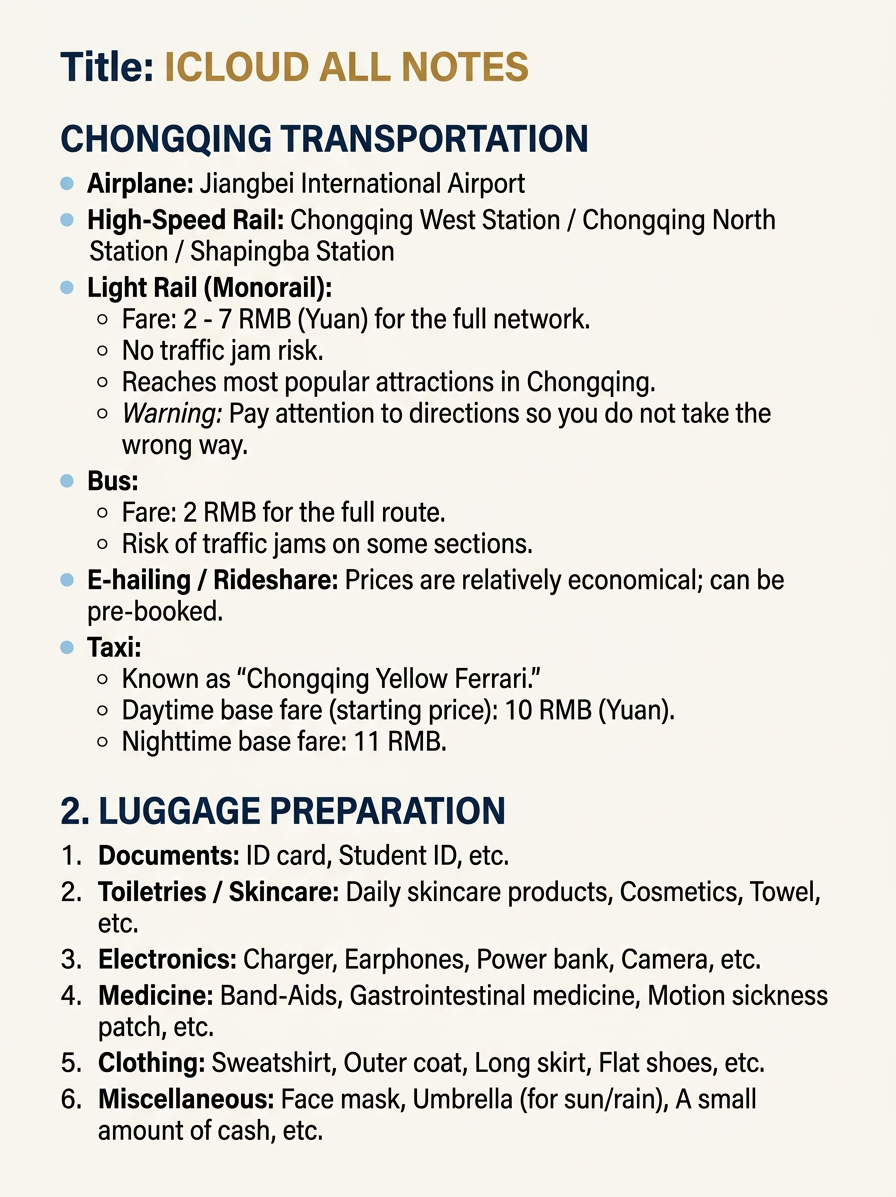
To explore central Chongqing across three days without physical exhaustion, organize your sightseeing strictly by municipal district: explore Yuzhong Peninsula on Day 1, take in cultural institutions and elevated transit across Yuzhong and the rail corridors on Day 2, and spend Day 3 across modern lifestyle clusters in Jiangbei. Rather than tackling exhausting vertical climbs between stacked road levels, substitute steep subway transfers with direct 20–30 RMB intra-district taxi hops, check platform departure boards carefully before boarding monorail lines, and request extra mild spice ("wei-wei-la") when dining.
Navigating the 3D Mountain City: Maps and Stair Traps
Standard smartphone map applications frequently struggle in central Chongqing because standard two-dimensional GPS displays cannot interpret multi-layered, vertical urban environments. Roads, suspended walkways, subterranean tunnels, and cliffside passages sit stacked directly above and below one another. A digital map may display an attraction as a flat 50-meter walk, yet that destination may actually sit ten structural stories higher on a cliff terrace or down a hidden hillside.
Pedestrian navigation demands active awareness. A single wrong turn can commit a traveler to a multi-tiered pedestrian footbridge, an underpass, or an outdoor concrete staircase that requires climbing several dozen flights just to return to the original street plane. When orientation becomes confusing, asking local residents or showing the destination in written Chinese characters is far more dependable than blindly following a wandering blue dot on a digital screen.
Transit Tactics: When to Take Metro vs. Inexpensive Taxis
Solo traveler tip
While Chongqing's rail transit network connects major tourist hubs, reaching the platforms often involves navigating long underground tunnels, multiple escalators, or extensive flights of concrete steps. For intra-district travel—such as connecting stops located within the same municipal zone—street taxis and ride-hailing cars provide an efficient physical relief valve. These short trips typically cost between 20 and 30 RMB. In practice, inner-city road congestion is often manageable, making short car hops an energy-saving alternative to grueling climbs.
Compare options
| Transit Mode | Typical Cost | Physical Exertion | Best Use Case |
|---|---|---|---|
| Intra-District Taxi / Ride-Hailing | 20–30 RMB | Minimal (curbside pick-up and drop-off) | Bypassing steep vertical stairways and cliffside elevation shifts |
| Rail Transit (Metro / Monorail) | 2–7 RMB | Moderate to High (deep station depths and stair climbs) | Crossing rivers between districts or traveling long horizontal distances |
When using the Chongqing rail transit (light rail/metro) system, pay attention not to board the train in the wrong direction. Because stations feature bi-level configurations and split platforms, travelers can easily get turned around. Always confirm the terminal station name displayed on overhead platform signage before stepping onto the carriage.
Day 1: Yuzhong Peninsula's Layered Icons
The first day concentrates entirely on the Yuzhong Peninsula, chaining together historic guildhalls, high-density residential architecture, modern riverfront landmarks, and cliffside lookouts without unnecessary backtracking.
- Jiefangbei: Begin at Chongqing's central pedestrian monument and clock tower.
- Baixiangju: Move east toward this classic residential complex known for its multi-level hillside construction.
- Huguang Yinxiang & Huguang Guild Hall: Continue down toward the bright yellow architectural complex overlooking the river.
- Raffles City Chongqing & Chaotianmen: Walk toward the confluence point of the Yangtze and Jialing rivers to inspect the modern sail-shaped skyscraper hub.
- Hongyadong: Head along the riverside to explore the multi-tiered stilt-house complex.
- Kuixinglou & Daijia Lane: Finish the circuit by heading to Kuixinglou's famous ground-level skybridge plaza before wandering the renovated cliffside alleys of Daijia Lane.
Pacing Tip: If an evening departure falls on Day 3, shift Hongyadong's evening light viewing into this first night to maintain a relaxed departure schedule.
Day 2: Heritage Landmarks, Liziba Monorail, and Creative Hubs
Day 2 balances significant regional cultural heritage in the morning with elevated infrastructure viewing and repurposed industrial spaces in the afternoon before crossing the river toward Jiangbei.
- Chongqing People's Auditorium: Start the morning taking in the traditional circular dome architecture of this municipal landmark.
- Three Gorges Museum: Walk across the open plaza to tour the regional cultural, historical, and geological exhibits.
- Liziba Station: Board Chongqing Rail Transit Line 2 to observe the famous monorail line passing directly through the sixth to eighth floors of a residential apartment structure, then step down to the street viewing platform for outward photographs.
- Eling Testbed 2: Ascend the hillside to explore the repurposed industrial print factory, now filled with open viewpoints, design boutiques, and relaxed cafes.
- Transit to Jiangbei / Guanyinqiao: Conclude the late afternoon by crossing the river north to settle into Jiangbei District for dinner.
Day 3: Modern Street Life and Commercial Districts
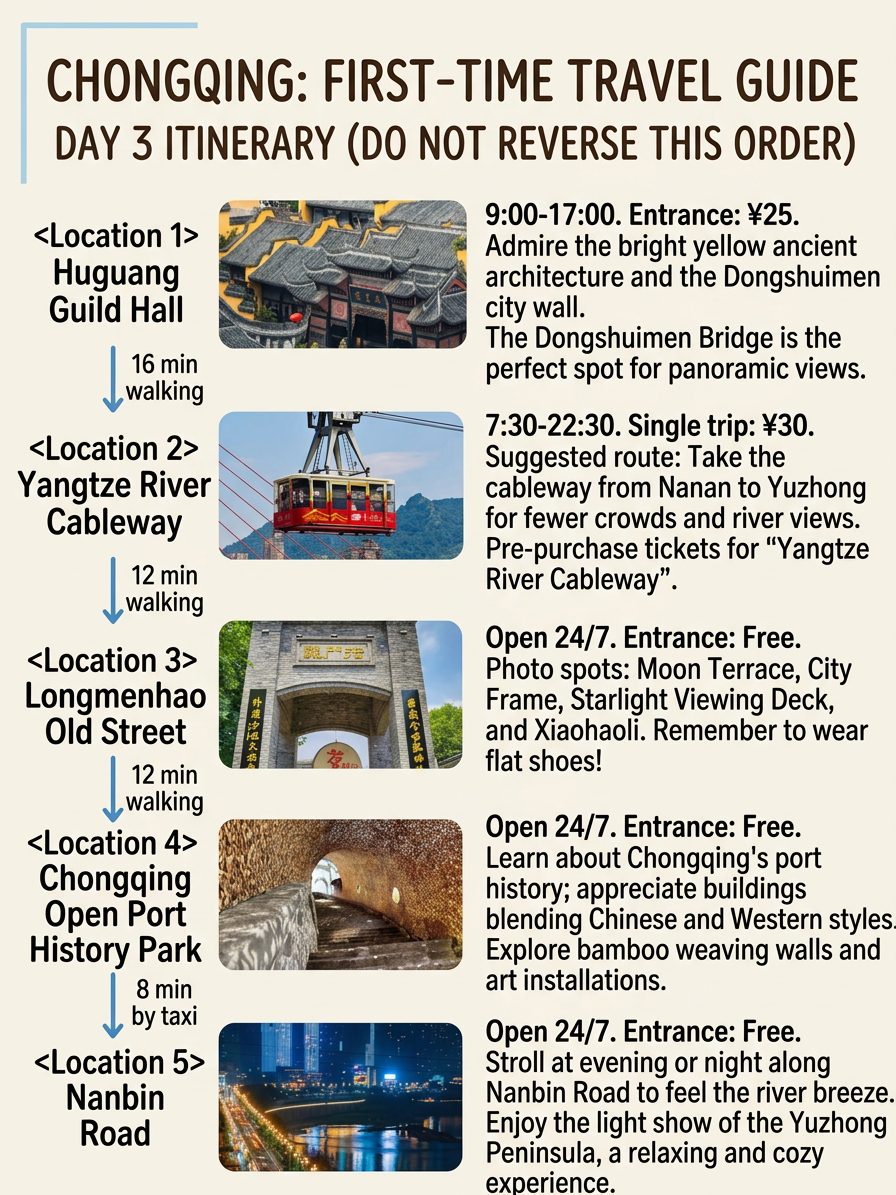
The third day explores modern retail culture, public installations, and trendy lifestyle quarters within Jiangbei District.
- Guanyinqiao Food Street: Sample regional snacks and local noodles in the dense street food stalls.
- Visual Installations: Walk past the giant "I am in Chongqing" outdoor screen and the public Hello Kitty statue in the pedestrian plaza.
- Taping: Explore the adjacent neighborhood of quiet hillside residential blocks converted into modern storefronts.
- Beicang Cultural Park: Spend the early afternoon browsing this compact creative quarter set inside converted textile warehouse spaces.
- Modern Commercial Circuit: Conclude the afternoon wandering the modern lifestyle hubs of the "Manhattan" photo spot, Starlight 68 Plaza, Paradise Walk, and Fangyuan LIVE.
Solo Dining and Pacing Considerations
Navigating Chongqing as a solo visitor requires active energy management. Even moderate daily walking routes involve continuous grade changes and concrete steps. Keep individual walking segments realistic, carry a translation tool with optical character recognition to read bi-level building signage, and utilize 20–30 RMB taxi hops whenever an elevation shift looks prohibitive on foot.
Dining requires equal care regarding regional chili heat. In Chongqing, standard "mild spicy" (wēilà, 微辣) is considerably hotter than mild dishes served in other Chinese provinces, and chili oils accumulate lingering intensity throughout a meal. If you possess a low tolerance for spice, always specify "extra mild" (wēiwēilà, 微微辣) when ordering hotpot or braised dishes, and avoid adding raw bird's eye chilies (xiǎomǐjiāo, 小米椒) into your sesame oil dipping sauce.
Frequently asked questions
Is digital GPS navigation reliable for walking in Chongqing?
Digital map navigation is often inaccurate in central Chongqing due to the city's complex 3D mountainous topography. Pedestrian overpasses, underground tunnels, and cliffside pathways stack vertically, so a destination that appears 50 meters away might actually sit 10 stories above or below you.
Why should I consider taxis over the monorail for short distances?
While the monorail system is extensive, accessing stations often requires climbing dozens of flights of stairs or traversing lengthy subterranean walkways. For trips within the same municipal district, taxis or ride-hailing cars are fast, inexpensive (typically 20 to 30 RMB), and save immense physical stamina.
What is the key transit mistake international travelers make on the Chongqing metro?
Due to split platforms and bi-level stations, travelers frequently board trains traveling in the opposite direction. Always double-check the final terminal station indicated on the platform signage before entering the rail carriage.
How spicy is hotpot in Chongqing for non-locals?
Chongqing's standard 'mild spicy' (微辣) is significantly hotter than the mild setting in other parts of China, and its heat builds steadily throughout the meal. If you are sensitive to spice, always order 'extra mild' (微微辣).