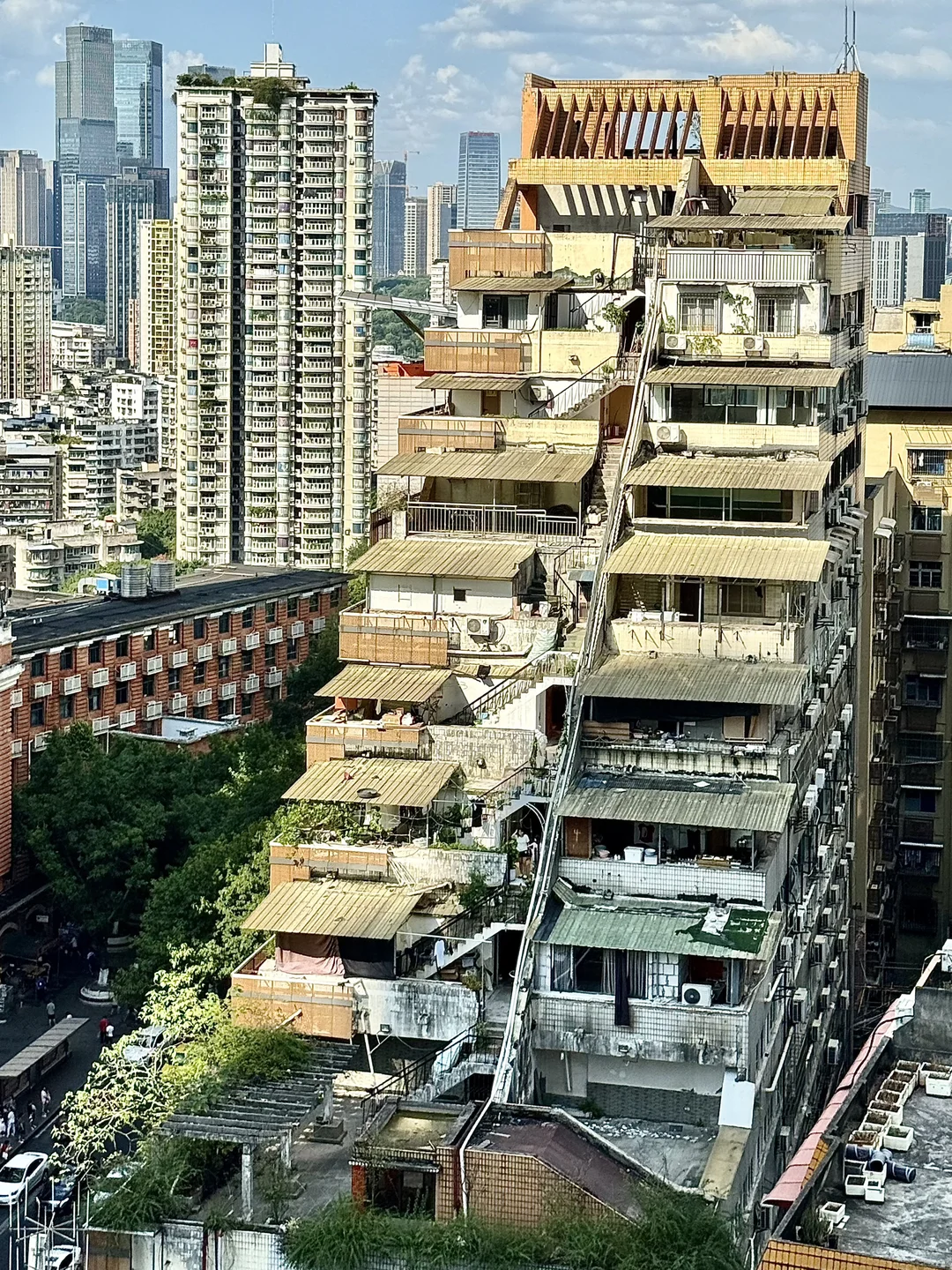
Chongqing presents an urban layout unlike any other metropolis on earth. Built across steep river ridges where the Yangtze and Jialing rivers converge, a street that appears to sit at ground level can suddenly turn out to be the rooftop of an eleven-story apartment tower. Attempting to explore this multi-layered environment with standard horizontal intuition leads quickly to physical exhaustion and stranded detours. This 48-hour itinerary organizes your movements into continuous downhill descents, bypassing navigation blind spots and connecting the essential historical landmarks of Yuzhong District with the contemporary cultural spaces across the river.
Essential Orientation: Handling the 3D Mountain City
The fundamental reality of Chongqing is that the city is built on continuous flights of stone steps (全是梯坎, quánshì tīkǎn). As a result, the urban core is emphatically not mobility-friendly. Travelers navigating with strollers, heavy wheeled luggage, or limited mobility will face continuous staircases where ramps do not exist. Comfortable walking footwear with cushioned soles and reliable grip is mandatory. Do not attempt to explore these districts in formal leather shoes or high heels, especially after rain when stone slabs become slick.
Public rail transit (轨道交通, guǐdào jiāotōng) is your primary lifeline across the city. You should rely almost exclusively on the light rail and metro lines rather than rental cars or surface street taxis. Chongqing’s vertical topography makes surface driving exceptionally challenging, and street parking is notoriously difficult and scarce near major landmarks. Station interchanges allow you to bypass congested surface choke points across river bridges.
Satellite-based smartphone navigation regularly malfunctions across the central peninsula. Because highways, skybridges, residential alleys, and rail viaducts stack directly on top of each other, GPS sensors struggle to determine your vertical elevation. A navigation app may insist you have arrived at your destination when the doorway is actually eighty meters above you up a hidden stairwell. If your digital map begins to drift or spins erratically, do not wander aimlessly down side alleys. Stop immediately and ask local residents for directions. Pointing to your destination name in Chinese characters will save significant physical effort.
Finally, structure your sightseeing around the sunset. Chongqing’s mountain nightscape is world-renowned, with illuminated cliffside architecture reflecting across the two broad rivers. Allocate ample evening hours specifically for wandering viewpoints and bridges rather than retreating early to your hotel room.
Day 1: Classic Yuzhong Peninsula from Cliffside Trails to Hongyadong
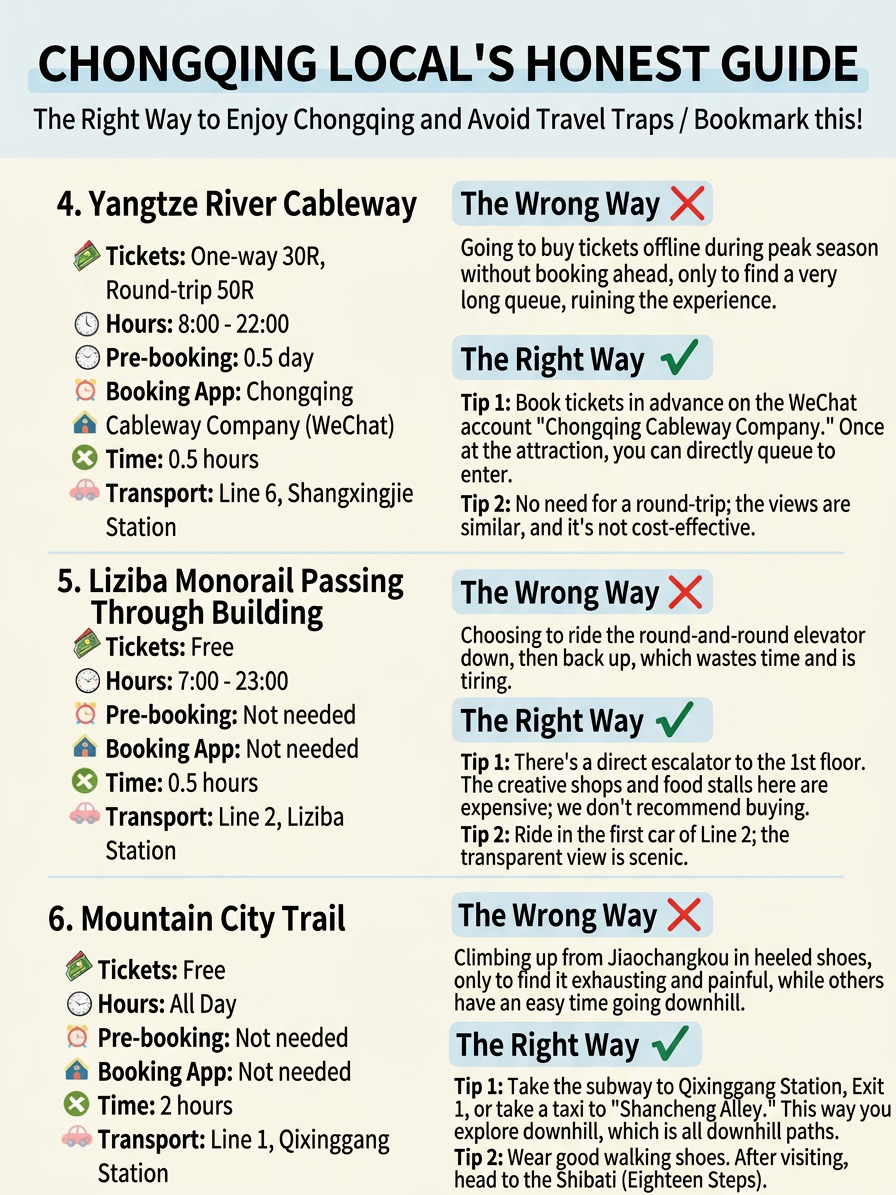
Your first day focuses entirely on the historic core of Yuzhong District (渝中区, Yúzhōng Qū). To conserve energy on Chongqing’s vertical slopes, begin your morning at the high elevation of Lingshi Lane (领事巷, Lǐngshì Xiàng). Entering here places you at the top entrance of the Mountain City Trail (山城步道, Shānchéng Bùdào), allowing you to walk downwards along the cliff edge facing the Yangtze River rather than climbing upwards against the slope.
From the Mountain City Trail, continue descending directly into Shibati (十八梯, Shíbātī), known as the Eighteen Stairs. This historic hillside settlement has been restored with shops and stone stairways. Continuing from Shibati brings you directly into the central plaza of Jiefangbei (解放碑, Jiěfàngbēi), the city’s central liberation monument and commercial core. Completing this entire walking sequence from the top of the Mountain City Trail through Shibati to Jiefangbei takes less than 120 minutes of relaxed walking.
Before you continue
From Jiefangbei, branch eastward through Baixiang Street (白象街, Báixiàng Jiē) toward Baixiangju (白象居, Báixiàngjū). This classic residential complex offers distinct vantage points where the Yangtze River Cableway cabins glide directly past mid-level residential balconies. When visiting Baixiangju, walk quietly through the open corridors and avoid disturbing local residents.
Continue downward toward the riverbank to reach Huguang Guild Hall (湖广会馆, Húguǎng Huìguǎn), an architectural complex dating to the Qing Dynasty featuring bright yellow exterior walls and stepped gables. Standard admission is 25 CNY, though seasonal adjustments occasionally see tickets priced up to 32 CNY at the on-site ticketing counter.
From the guild hall, connect past the soaring towers of Raffles City at Chaotianmen (朝天门来福士, Cháotiānmén Lái Fú Shì) before making your way toward Hongyadong (洪崖洞, Hóngyádòng). Hongyadong is a stilt-house complex clinging to the steep river cliff, crowned at night by brilliant golden illumination.
A crucial transit warning applies here: the commercial floors inside Hongyadong are intensely crowded and offer standard souvenir stalls. If your priority is viewing the illuminated exterior rather than browsing indoor retail stalls, do not descend inside the structure to the ground floor. Taking elevators or stairs down into the lower street level creates severe bottlenecks and leaves you with an exhausting uphill climb or heavy pedestrian traffic when crossing toward Jiangtan Park (江滩公园, Jiāngtān Gōngyuán). Instead, enjoy the skyline views from the Cangbai Road terrace on the 11th floor, then walk across Qianshimen Bridge (千厮门大桥, Qiānsīmén Dàqiáo) to reach the river beach opposite the structure for unobstructed panoramic photography.
Be alert to common street solicitations near Hongyadong and Jiefangbei. Ignore street touts offering paid fast-track tickets or private elevator access to skip Hongyadong queues; these individuals simply lead visitors through ordinary residential stairwells. Decline interactions with street performers posing as bronze statues, as posing for pictures triggers a 20 CNY photo fee. You should also refuse flowers or red fruit offered by roadside vendors, as these involve aggressive sales tactics.
Day 2: Cultural Heritage, Downhill Ridges, and Modern Cityscapes
Day 2 spans cultural sites across Yuzhong District before crossing north into the contemporary neighborhoods of Liangjiang New Area (两江新区, Liǎngjiāng Xīn Qū). Start your morning along the ridge at Eling Park (鹅岭公园, Élǐng Gōngyuán) and the adjacent TESTBED2 creative cultural park (鹅岭二厂, Élǐng Èrchǎng), an industrial design hub repurposed from an old banknote printing facility.
Before you continue
When connecting between TESTBED2 and the Liziba monorail viewpoint, routing direction is critical. You must travel strictly downhill from Eling Erchang down to Liziba (李子坝, Lǐzǐbà). Reversing this order requires climbing hundreds of vertical hillside steps from the riverbank to the mountain ridge. Descending on foot allows you to arrive smoothly at the ground-level viewing platform to observe Line 2 trains passing directly through the sixth to eighth floors of the residential apartment building.
Board Line 2 at Liziba and travel eastward toward the Chongqing People’s Auditorium (重庆市人民大礼堂, Chóngqìng Shì Rénmín Dàlǐtáng). The traditional circular rotunda is visually striking from the plaza. For wide-angle photography that captures the scale of the auditorium facade, walk inside the grounds entrance and up the front stone steps, using the classical stone pillar railings to frame your shot.
Directly across the public square sits the Three Gorges Museum (重庆中国三峡博物馆, Chóngqìng Zhōngguó Sānxiá Bówùguǎn). The walk between the People’s Auditorium and the museum entrance takes approximately 10 minutes across the open pedestrian plaza. Admission to the Three Gorges Museum is completely free of charge (0 CNY), though visitors must present their passports at security or make an advance digital entry reservation. Note that the museum is closed on Mondays, so plan your weekend itinerary accordingly.
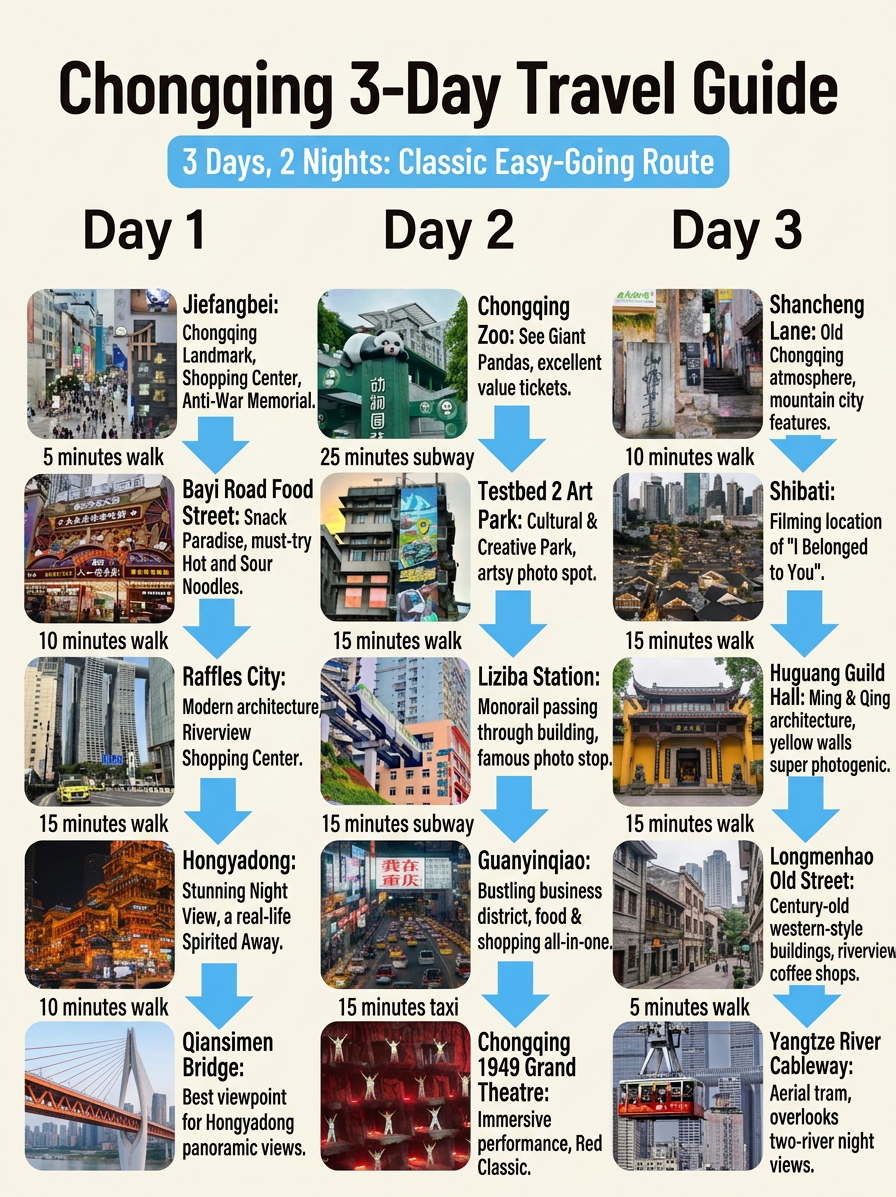
In the late afternoon, take the rail transit across the Jialing River into Jiangbei to explore Beicang Cultural and Creative Park (北仓文创街区, Běicāng Wénchuàng Jiēqū), a quiet former textile warehouse converted into independent bookshops, coffee bars, and gardens. Conclude your evening in the bustling commercial heart of Guanyinqiao (观音桥, Guānyīnqiáo), a district loved by local youth for street shopping, neon outdoor video screens, and vibrant casual dining.
Where to Base Yourself and How to Survive Chongqing Hotpot
Selecting your accommodation base requires balancing walking access against crowds and noise. If this is your first visit, staying within walking distance of Jiefangbei offers unmatched convenience for Day 1 landmarks and metro hubs, though room prices are higher and central streets stay busy late into the night. If you prefer quieter evenings, better room value, and modern shopping malls, consider booking near Guanyinqiao in Jiangbei. The metro connects Guanyinqiao to the Yuzhong historic peninsula in just a few stops. Travelers prioritizing dramatic river views can look along Nanbin Road (南滨路, Nánbīn Lù), while budget-focused independent travelers often favor Shapingba (沙坪坝, Shāpíngbà) for low-cost student dining near universities.
Chongqing’s culinary calling card is beef-tallow hotpot (牛油火锅, niúyóu huǒguō), but uninitiated travelers must approach ordering with realistic caution. Hotpot broths here use massive quantities of dried chilies, fermented chili paste, and Sichuan peppercorns simmered in rich beef fat. Most local hotpot establishments allow guests to select their spiciness level (辣度, làdù). Foreign travelers must be aware that even mild spice (微辣, wēilà) in Chongqing is intensely hot by international standards, easily surpassing the heat of typical Western or East Asian spicy cuisines. If your personal spice tolerance is moderate or low, request a split dual-flavor pot (鸳鸯锅, yuānyāng guō), which pairs a spicy chili broth on one side with a mild mushroom or bone broth (清汤, qīngtāng) on the other. Dip cooked meats into a bowl of pure sesame oil mixed with crushed garlic; the oil cools the food and coats the stomach against the chili oils.
To find genuine hotpot quality, avoid glitzy, influencer-promoted restaurants clustered directly along tourist plazas. Venues boasting themes like air-raid shelters (防空洞, fángkōngdòng) or excessive marketing gimmicks often deliver mediocre food at inflated prices. Instead, look for established neighborhood community shops tucked into residential streets, such as Sanjing Hotpot (三井火锅, Sānjǐng Huǒguō) or Yibiaochang Hotpot (仪表厂火锅, Yíbiǎochǎng Huǒguō). Eating where local families and working residents dine guarantees authentic tallow seasoning, fresh cuts of beef tripe and pork aorta, and fair, transparent pricing.